




Email Marketing
Email Marketing for Small Businesses: How to Build Your List and Increase Conversions
Email marketing remains a useful way for businesses to communicate with customers, share valuable information and promote products or services. Unlike social media, where visibility can depend heavily on platform algorithms, email allows businesses to reach people who have chosen to receive their messages directly in their inbox.
However, successful email marketing involves more than sending occasional promotions. Businesses need to understand their audience, create relevant messages, maintain a healthy subscriber list and measure whether their campaigns achieve meaningful results.
Whether you run an online store, a service-based business, a blog or a growing company, an effective email marketing strategy can help you build stronger customer relationships and encourage repeat business.
In this guide, we will explore how email marketing works, how to grow a subscriber list responsibly, how to create effective campaigns and which metrics can help you improve performance.
1. What Is Email Marketing and Why Does It Matter?
Email marketing is the use of email to share information, communicate with subscribers and support business goals. Depending on the audience and purpose, campaigns may include newsletters, educational resources, product announcements, promotional offers and customer updates.
Businesses can also use automated emails to deliver messages in response to particular actions, such as signing up for a newsletter or placing an order.
When used responsibly, email marketing offers several benefits:
- Direct communication: Reach people who have agreed to receive your messages.
- Customer relationship building: Share useful information and stay connected with your audience.
- Product and service promotion: Explain offers, announce launches and highlight relevant solutions.
- Repeat engagement: Encourage existing customers to return when your products or services meet their needs.
- Measurable performance: Track delivery, clicks, conversions and other useful indicators.
- Marketing efficiency: Communicate with a subscriber base without relying entirely on paid advertising.
Email marketing is not automatically profitable, and sending more emails does not necessarily produce better results. Success depends on message relevance, audience quality, timing, deliverability and the value of the offer.
A good strategy prioritises the subscriber experience rather than treating every email as a sales opportunity.
2. How to Build a Quality Email Subscriber List
A relevant subscriber list is one of the foundations of effective email marketing. The goal is not simply to collect as many addresses as possible, but to attract people who genuinely want to hear from your business.
Offer a clear reason to subscribe
People are more likely to sign up when they understand what they will receive and why it may be useful.
Depending on your business, you could offer:
- A practical guide or checklist.
- Helpful industry tips.
- Product updates and announcements.
- Relevant educational articles.
- Early access to selected offers.
- A newsletter covering a specific topic.
Explain the expected content and frequency before someone subscribes. Avoid promising benefits that you cannot consistently deliver.
Place signup forms where they make sense
A subscription form can appear on a relevant blog page, within a useful resource, at the end of an article or on a dedicated landing page.
Keep the form simple. Request only the information you genuinely need, and explain how the subscriber’s details will be used.
If your business serves different audiences, consider creating separate signup opportunities for distinct interests. For example, a digital services business may have readers interested in SEO, website maintenance or email marketing.
Use clear consent practices
Build your list through legitimate methods and follow the privacy and electronic marketing laws that apply to your business and subscribers.
Depending on the circumstances and jurisdiction, this may require explicit consent or another legally valid basis for communication. Explain what people are signing up for, keep appropriate records and make unsubscribing straightforward.
Do not purchase random email lists or add people to promotional campaigns without an appropriate legal basis. Purchased lists can contain outdated addresses and people who never agreed to hear from you, increasing complaints and damaging your sender reputation.
Keep your subscriber list healthy
Over time, some addresses become inactive or stop receiving messages. Monitor repeated delivery failures, remove invalid addresses and review long-term inactivity.
You can sometimes run a carefully designed re-engagement campaign for inactive subscribers, provided you have an appropriate basis to contact them. If people do not respond, consider suppressing them from future marketing emails.
A smaller, relevant and engaged list can be more useful than a large list filled with uninterested recipients.
3. How to Write Emails That People Want to Read
An effective email should have a clear purpose and make it easy for the reader to understand the message.
Write a clear subject line
The subject line should accurately communicate the email’s main topic or benefit.
For example, a business offering website services might use a subject line such as “Five Website Checks to Complete This Month.” This tells the reader what the email contains without relying on exaggerated claims.
Avoid misleading subject lines, excessive punctuation and promises that the email does not fulfil. Subject lines should attract relevant attention, not trick people into opening a message.
Make the opening useful
Readers should quickly understand why the email matters to them. Start with the main announcement, a relevant question or the practical benefit of the message.
Avoid long introductions that delay the important information. A concise email with one clear purpose is often easier to read than a message trying to communicate several unrelated offers.
Provide genuine value
Your email could teach subscribers something, explain a product feature, answer a common question or offer a relevant promotion.
For example, an email marketing service provider might share a short checklist for improving newsletter engagement before inviting readers to explore professional assistance.
Balance promotional content with useful information. The right mix depends on your audience, business model and the expectations established when subscribers signed up.
Include one clear call to action
A call to action tells readers what to do next. Examples include:
- Read the full guide.
- Explore a service.
- Request a quote.
- View a product.
- Register for an event.
- Update email preferences.
Make the action relevant to the email’s purpose. Too many competing links can make it harder for readers to decide what matters most.
Optimise for mobile devices
Many people read emails on smartphones. Use readable font sizes, short paragraphs, clear spacing and links or buttons that are easy to tap.
Ensure that images display appropriately and that the email remains understandable when images are blocked. Include meaningful alternative text for important images, and test the layout across common email clients when possible.
4. Email Automation, Segmentation and Personalisation
Email automation and segmentation help businesses deliver more relevant messages without manually creating every campaign.
Segment subscribers by relevant interests
Segmentation means dividing your audience into groups based on useful information, such as interests, customer status or previous interactions.
For example, a business that offers several digital services could send website maintenance guidance to subscribers interested in technical support while sharing SEO resources with readers who prefer search marketing topics.
Segments should reflect information you have collected appropriately. Avoid making intrusive assumptions about subscribers or collecting unnecessary personal information.
Use automation for appropriate customer journeys
Automated emails can be triggered by events or actions, helping businesses send timely and relevant messages.
Common examples include:
- Welcome emails: Introduce the business and explain what subscribers can expect.
- Educational sequences: Deliver a series of useful lessons or resources.
- Order confirmations: Provide essential information after a purchase.
- Service updates: Communicate relevant changes to customers.
- Follow-up emails: Invite feedback or provide additional guidance after an interaction.
Some automated messages are transactional, while others are marketing communications. Their legal requirements may differ, so make sure each message is categorised and managed appropriately.
Personalise without overdoing it
Personalisation can include addressing someone by their preferred name, tailoring content to their stated interests or recommending relevant resources based on appropriate interactions.
Personalisation should improve relevance rather than make readers uncomfortable. Do not imply that you know more about a subscriber than they would reasonably expect.
Most importantly, personalisation cannot compensate for an unhelpful message. The underlying content still needs to meet the reader’s needs.
Test timing and frequency
There is no single best email frequency for every business. Some audiences appreciate a weekly newsletter, while others prefer occasional updates.
Set expectations when people subscribe and monitor unsubscribes, complaints and engagement. Test different sending schedules carefully, and avoid increasing frequency simply to meet a marketing target.
5. How to Measure Email Marketing Performance
Measuring email performance helps businesses understand whether campaigns are reaching subscribers and supporting their objectives.
The most useful metrics depend on what an email is designed to achieve.
| Metric | What it helps you understand |
|---|---|
| Delivery rate | The proportion of sent emails accepted for delivery, based on the provider’s reporting method |
| Bounce rate | The proportion of emails that could not be delivered |
| Open rate | The proportion reported as opened, subject to privacy and tracking limitations |
| Click-through rate | The proportion of recipients or delivered messages generating tracked clicks, depending on the reporting definition |
| Conversion rate | The proportion completing a defined action, such as purchasing or submitting a form |
| Unsubscribe rate | How frequently recipients opt out |
| Complaint rate | How frequently recipients report messages as spam |
| Revenue or leads | The business outcomes associated with the campaign |
Focus on conversions, not just opens
Open rates can be affected by privacy features, image loading behaviour and automated activity. They should not be treated as a precise measure of human interest.
Clicks can also include automated security scans, so click data may require interpretation.
Where possible, connect campaign activity to meaningful actions such as qualified enquiries, purchases or registrations. Use suitable analytics and tracking methods while respecting privacy requirements.
Test one important variable at a time
Testing can help you understand which approaches work better for your audience. You might compare subject lines, calls to action, email formats or different versions of a landing page.
Define the success metric before running a test. A subject line that increases opens but reduces qualified conversions may not improve the overall campaign.
Ensure that you have enough data to make a reasonable comparison, and avoid drawing strong conclusions from very small samples.
Maintain strong email deliverability
Deliverability is influenced by factors such as sender reputation, recipient engagement, authentication, list quality and sending practices.
For a business sending email from its own domain, appropriate email authentication may include SPF, DKIM and DMARC. The exact configuration depends on the email service and domain setup.
Use a reputable email service provider, send to appropriately sourced contacts, remove invalid addresses and respect unsubscribe requests promptly. Monitor delivery errors and spam complaints rather than repeatedly sending to recipients who do not want your messages.
Where to Find Era24UK’s Email Marketing and Digital Services
If you are exploring email marketing, SEO, website traffic or related digital services, the following publicly accessible Era24UK profiles and listing can be used as starting points:
- SEOClerks profile: Era24UK on SEOClerks
- LinkedIn profile: Era24UK on LinkedIn
- Website traffic listing: 100K USA Organic Traffic listing
These links provide places to review publicly available information, but they should not be taken as confirmation that email marketing is included in any particular service package.
Before ordering, contact the provider to confirm whether email campaign creation, template design, automation, list management, deliverability support or reporting is available. Ask about pricing, access requirements, delivery terms and the responsibilities of each party.
Summary: Which Service Is Right for You?
| Your goal | Most relevant service |
|---|---|
| Build a new website | Website development |
| Fix or manage an existing WordPress site | WordPress support and maintenance |
| Improve Google search visibility | SEO |
| Improve visibility in AI-powered search | GEO, AEO, AIO and LLM optimisation |
| Attract customers through online campaigns | Digital marketing |
| Send newsletters and promotional emails | Email marketing |
| Edit videos for a YouTube channel | YouTube video editing |
| Resolve hosting, domain or server issues | Hosting and technical support |
| Maintain a website’s functionality and security | Website maintenance and security |
| Increase visits or configure website monetisation | Traffic and monetisation support |
Conclusion
Email marketing can help businesses communicate directly with interested audiences, build customer relationships and support repeat engagement. Its effectiveness depends on more than sending frequent messages: businesses need relevant subscribers, useful content, responsible data practices and a clear understanding of campaign performance.
Start by defining your objectives, explaining the value of subscribing and creating emails that fulfil the expectations you set. Use segmentation and automation where they genuinely improve relevance, and monitor conversions alongside deliverability and subscriber feedback.
With a thoughtful approach, email marketing can become a valuable part of a broader digital marketing strategy.
SEO Publishing Details
SEO title: Email Marketing for Small Businesses: Build and Convert
Meta description: Discover how to build an email list, write engaging newsletters, use automation, improve deliverability and measure email marketing performance.
Suggested URL slug: email-marketing-for-small-businesses
Primary keyword: email marketing for small businesses
Related keywords: email marketing strategy, email campaign management, email automation, newsletter marketing, email list building, email deliverability
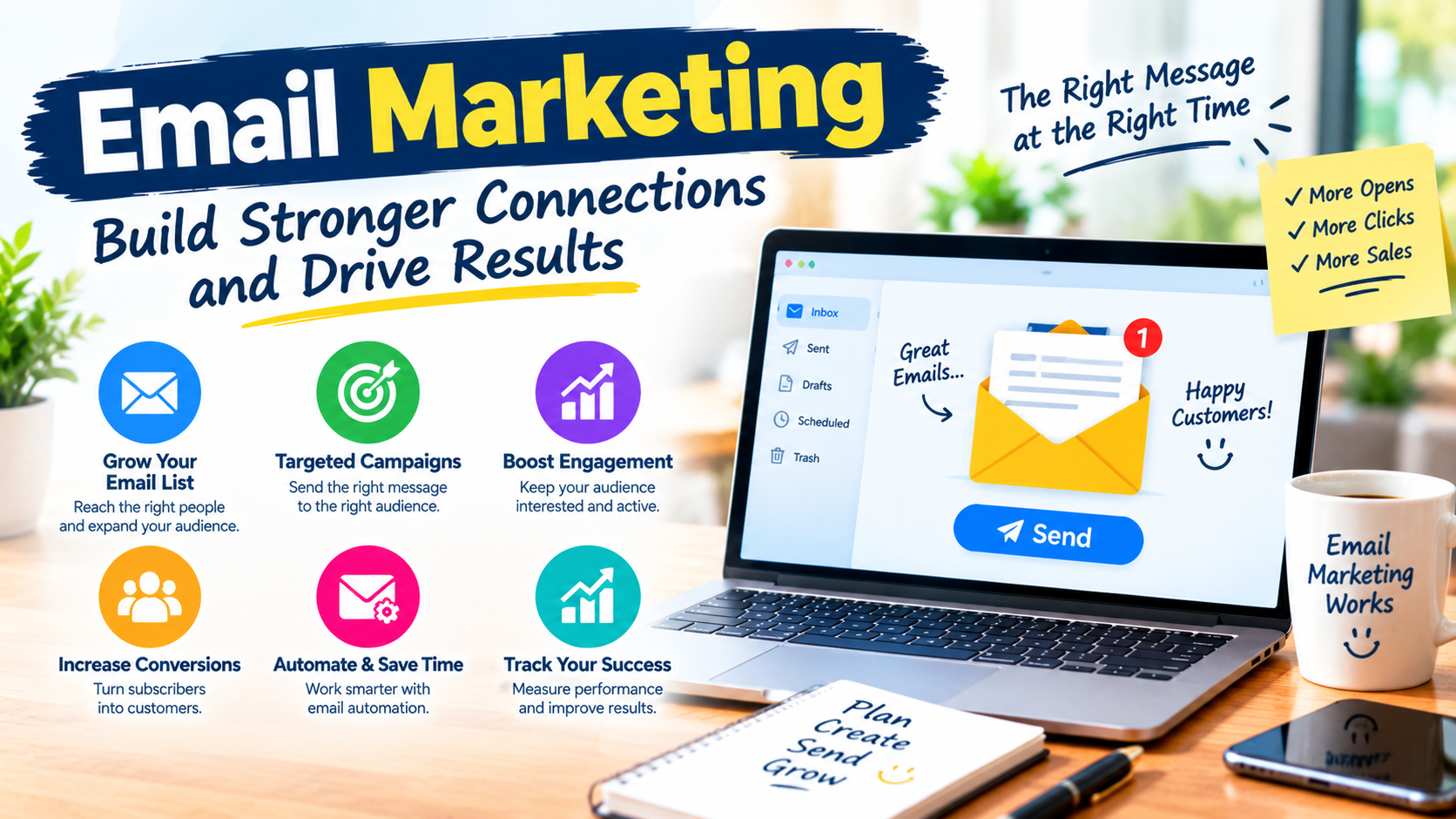
Suggested featured image concept: A professional marketing workspace featuring a laptop displaying a generic email campaign dashboard, a smartphone with a newsletter layout, an envelope symbol and a simple analytics chart. Use a clean, modern composition with realistic lighting, no readable text, no logos and no watermarks.


Leave a comment