





Search Engine Optimisation (SEO)
SEO for Beginners: How to Improve Your Website’s Google Rankings and Attract More Visitors
Having a website is an important first step for any online business, but simply publishing a website does not guarantee that potential customers will find it. With millions of pages competing for attention, businesses need a clear strategy to improve their visibility in search engines and attract relevant visitors.
This is where search engine optimisation (SEO) comes in. SEO involves improving your website’s content, structure, technical performance and overall usefulness so that search engines can understand your pages and connect them with relevant searches.
Whether you run a small business, an online store, a blog or a professional service website, an effective SEO strategy can help you reach people who are already looking for the products, services or information you offer.
In this guide, we will explain how SEO works, which areas deserve attention and how you can build a practical strategy for sustainable organic growth.
1. What Is SEO and Why Does It Matter?
Search engine optimisation is the process of improving a website’s visibility in the unpaid results of search engines such as Google. Unlike paid advertising, organic search traffic does not require payment for each click, although SEO itself can require time, tools and professional investment.
SEO helps search engines discover your pages, understand their content and determine how relevant they are to a particular search query.
For businesses, this can provide several benefits:
- Increased online visibility: More opportunities to appear when potential customers search for relevant topics.
- Relevant website traffic: The ability to reach people looking for information, products or services related to your business.
- Improved user experience: Better navigation, clearer content and a more accessible website.
- Long-term marketing value: Useful pages may continue attracting visitors after publication, although rankings and traffic can change over time.
- More opportunities for enquiries and sales: Relevant visitors may be more likely to take action when your website meets their needs.
SEO is not a guaranteed shortcut to the top of Google. Results depend on competition, content quality, technical conditions, the website’s existing authority and many other factors. A realistic strategy focuses on sustained improvement rather than instant ranking promises.
2. Start With Keyword Research and Search Intent
Keyword research helps you understand the language people use when searching online. It also helps you decide which topics deserve dedicated pages and what information each page should provide.
However, effective keyword research is not simply about finding popular phrases and repeating them throughout an article. You need to understand the reason behind each search.
Understand the different types of search intent
Search intent describes what a person is trying to accomplish when entering a query.
Common types include:
- Informational intent: The person wants to learn something, such as how to improve website speed.
- Navigational intent: The person wants to find a particular website or brand.
- Commercial investigation: The person is comparing products or services before making a decision.
- Transactional intent: The person is ready to take action, such as purchasing a service or requesting a quote.
Matching a page to the correct intent helps you create more relevant content. For example, someone searching for “what is SEO” probably needs an educational article, while someone searching for “SEO services for small businesses” may be comparing providers.
Choose relevant keywords
Look for keywords that closely match your products, services and audience. Consider their search intent, competitiveness, business relevance and the type of content currently appearing in search results.
Useful research methods include reviewing search suggestions, analysing competitors’ publicly available pages and using keyword research tools.
Avoid targeting a keyword solely because it has high search volume. A smaller group of highly relevant visitors may be more valuable than a large number of people who have no interest in your offering.
Create a clear content plan
Organise your keywords into related topics. A service business, for example, might create separate pages for its core services, locations served, frequently asked questions and educational resources.
Each page should have a distinct purpose. Avoid creating numerous near-identical pages that provide little additional value or competing with your own pages for the same search intent.
3. Improve On-Page SEO and Content Quality
On-page SEO involves improving individual pages so that their topics, structure and information are clear to both visitors and search engines.
Write useful, descriptive titles and headings
Each important page should have a clear title that accurately describes its content. Include the primary keyword naturally where appropriate, but prioritise clarity over keyword repetition.
Use headings to organise information logically. A clear hierarchy helps readers scan an article and understand how its sections relate to one another.
For blog posts, a practical structure often includes:
- A headline that communicates the main benefit or topic.
- An introduction that explains the reader’s problem.
- Organised sections that answer relevant questions.
- Examples, instructions or evidence that make the content useful.
- A conclusion that summarises the key points and suggests an appropriate next step.
Create content that genuinely helps readers
Content should answer the questions your audience is likely to have. Explain important concepts clearly, provide practical guidance and avoid unnecessary repetition.
Where appropriate, include original experience, examples, demonstrations, expert input or useful supporting information. Review older pages when facts, services or recommendations change.
AI tools can assist with research and drafting, but publishing large quantities of generic or unverified material is not a reliable SEO strategy. The final content should be accurate, useful and reviewed for quality.
Optimise images and internal links
Use descriptive image filenames and meaningful alternative text when images communicate information. Compress images appropriately so they do not unnecessarily slow down the page.
Internal links help visitors discover related pages and help search engines understand the relationships between different parts of your website. Use descriptive anchor text and link to genuinely relevant resources.
Write useful meta descriptions
A meta description provides a short summary of a page. Search engines may use it to generate the search-result snippet, although they can display different text depending on the query.
Write a unique, accurate description that explains what the page offers. Treat it as a way to communicate value to potential visitors, not as a guaranteed ranking factor.
4. Technical SEO: Make Your Website Easy to Access and Use
Even excellent content can struggle to perform if search engines cannot access important pages or users encounter serious technical problems.
Technical SEO focuses on the website’s accessibility, structure and performance.
Check indexing and crawling
Search engines need to discover and process your pages before those pages can appear in relevant search results. Review whether important pages are accessible and whether accidental settings are preventing them from being indexed.
An XML sitemap can help search engines discover relevant URLs. Robots directives and canonical tags should also be configured correctly for the website’s needs.
A sitemap does not guarantee indexing, and submitting a page does not guarantee that it will rank.
Improve page speed and mobile usability
Many visitors browse on mobile devices, so your website should display and function properly across different screen sizes.
Pay attention to image sizes, unnecessary scripts, server response times and inefficient plugins. Use performance testing tools to identify specific bottlenecks rather than making changes based on guesswork.
Google’s Core Web Vitals provide useful measures of loading performance, responsiveness and visual stability. Improving them can contribute to a better user experience, although strong scores alone do not guarantee high rankings.
Use HTTPS and maintain a clear site structure
HTTPS helps protect data exchanged between the website and its visitors. Ensure your security certificate is valid and that pages consistently use the intended secure version of your domain.
Organise your website logically, with clear navigation and descriptive URLs. Fix broken internal links and use redirects carefully when pages move or URLs change.
For larger websites, a sensible structure can also make it easier for search engines to discover important content.
5. Measure SEO Performance and Keep Improving
SEO requires ongoing evaluation. Instead of judging success only by a few keyword positions, monitor a combination of visibility, traffic, engagement and business outcomes.
Use reliable measurement tools
Google Search Console can help you review search impressions, clicks, queries, indexing information and certain technical issues. Website analytics tools can provide additional insight into visitor behaviour and conversions.
Useful metrics include:
- Organic clicks: How many visits arrive through unpaid search results.
- Search impressions: How often your pages appear in search results.
- Click-through rate: The proportion of impressions that result in clicks.
- Keyword visibility: How your website appears for relevant search queries.
- Conversions: Enquiries, purchases, registrations or other valuable actions.
- Technical health: Issues affecting crawling, indexing, accessibility or performance.
Interpret metrics in context. A rise in traffic is not necessarily beneficial if visitors are irrelevant, while a modest increase in targeted enquiries may represent meaningful progress.
Build authority through useful resources and relevant mentions
Create resources that others may find useful enough to reference. These could include original research, detailed guides, practical tools, case studies or clear explanations of complex topics.
Relevant links from other websites can help search engines discover pages and may contribute to how they assess a site’s prominence. However, buying manipulative links, participating in link schemes or creating low-quality pages purely to obtain backlinks can put your search visibility at risk.
Focus on earning genuine attention through useful content and legitimate outreach.
Review and update your strategy
Review important pages periodically. Check whether the content remains accurate, whether search intent has changed and whether visitors can easily find the information they need.
Prioritise changes based on evidence. For example, a page receiving impressions but few clicks may need a clearer title, while a page attracting visitors but generating few enquiries may need more relevant content or a better conversion path.
SEO is an ongoing process of researching, improving, measuring and adapting.
Where to Find Era24UK’s SEO and Digital Services
If you want to explore SEO-related services, website traffic support or other digital services, the following publicly accessible Era24UK profiles and listing may be useful starting points:
- SEOClerks profile: Era24UK on SEOClerks
- LinkedIn profile: Era24UK on LinkedIn
- Website traffic listing: 100K USA Organic Traffic listing
These links are starting points for checking publicly available information. The traffic listing relates to website traffic and should not be assumed to represent a complete SEO service.
Before ordering, contact the provider to confirm which services are currently available, what work is included, how delivery is handled and what results can reasonably be expected. Be cautious of guarantees of specific Google rankings or instant organic traffic growth.
Summary: Which Service Is Right for You?
| Your goal | Most relevant service |
|---|---|
| Build a new website | Website development |
| Fix or manage an existing WordPress site | WordPress support and maintenance |
| Improve Google search visibility | SEO |
| Improve visibility in AI-powered search | GEO, AEO, AIO and LLM optimisation |
| Attract customers through online campaigns | Digital marketing |
| Send newsletters and promotional emails | Email marketing |
| Edit videos for a YouTube channel | YouTube video editing |
| Resolve hosting, domain or server issues | Hosting and technical support |
| Maintain a website’s functionality and security | Website maintenance and security |
| Increase visits or configure website monetisation | Traffic and monetisation support |
Conclusion
SEO helps businesses connect with people who are actively searching for relevant information, products and services. A strong strategy combines keyword research, useful content, sound technical foundations and consistent performance measurement.
Rather than chasing shortcuts, focus on understanding your audience, answering their questions and making your website accessible and easy to use. Track meaningful results, improve pages based on evidence and give your strategy time to develop.
With a clear plan and consistent effort, SEO can become a valuable part of your long-term digital marketing strategy.
SEO Publishing Details
SEO title: SEO for Beginners: Improve Google Rankings and Traffic
Meta description: Learn how SEO works, from keyword research and on-page optimisation to technical SEO and performance tracking. Discover practical ways to improve website visibility.
Suggested URL slug: seo-for-beginners-guide
Primary keyword: SEO for beginners
Related keywords: search engine optimisation, improve Google rankings, on-page SEO, technical SEO, keyword research, organic website traffic
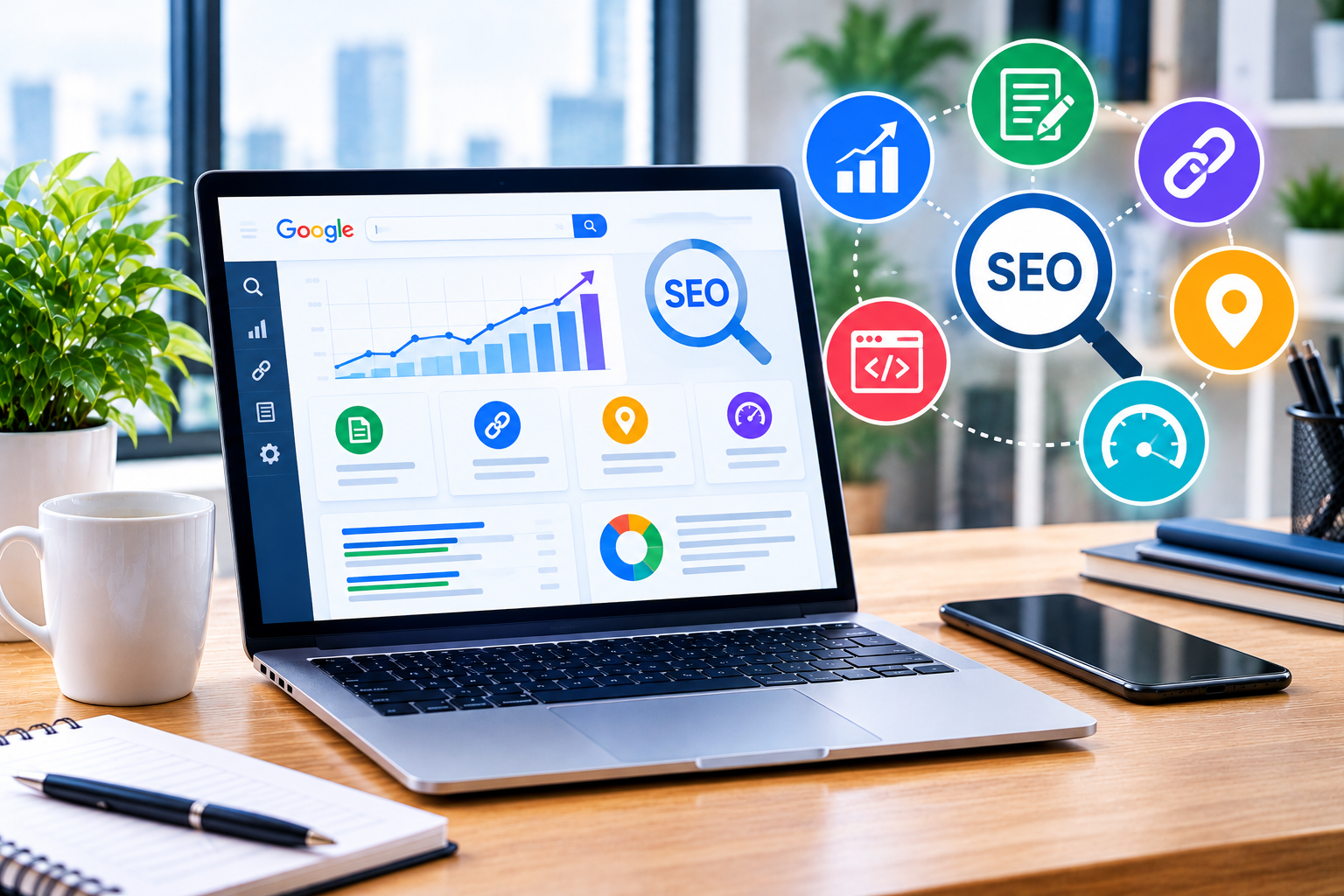
Suggested featured image concept: A professional digital marketing workspace featuring a laptop with abstract search analytics, a magnifying glass, search-result elements and a rising performance graph. Use a clean, modern style with realistic lighting, no readable text, no logos and no watermarks.


Leave a comment